

A loafer has no laces. That sounds obvious until you try one on, because it changes everything about how the shoe has to fit. There is nothing to tighten and nothing to loosen. The shoe either holds your heel or it does not, and no amount of breaking in will rescue a pair that was half a size too generous on the day you bought it.
That is the whole argument for buying loafers in person, and it is most of what we will tell you when you come in.
Where it came from
The loafer is Norwegian before it is American. In Aurland, on the western fjords, Nils Gregoriusson Tveranger was making a slip-on through the early 1900s that borrowed its construction from moccasins. Local fishermen and farmers wore them. They were work shoes.

The shoes reached America, and in 1936 G.H. Bass put out a version called the Weejun. The name is a worn-down version of the word Norwegian. Bass added a strap across the front with a cut-out in the middle, and that shape is the one everybody now pictures when they hear penny loafer.
As for why it is called a penny loafer, you will read that American students kept a coin in the slot for a payphone. It is a good story. We have never seen it properly sourced, so we will leave it as a story rather than repeat it as a fact. What is certain is that the cut-out was decorative first and got its name afterward.
The three on the floor right now
We have fifty-four pairs in the shop across three makers, and they sit at three genuinely different places. This is not the same shoe at three prices.
Barbour Carty, taupe suede, $329. The one to buy if you are not sure loafers are for you. Soft, light, cut for weekends rather than the office. It is the least formal shoe here and the easiest to wear with denim on a Saturday.
Doucal's, $499 to $699. The middle of the range and the deepest part of our buy, made in the Marche, the shoemaking region on Italy's Adriatic side. The black Napatto penny and its brown twin are the pair most men here end up in. The black woven at $699 is the dressiest thing Doucal's makes for us, and the unlined brown suede is the softest.
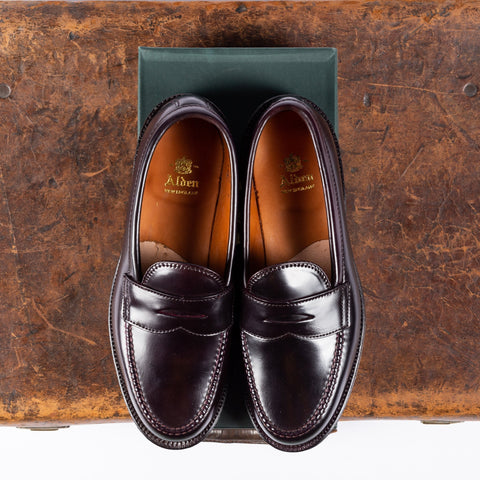
Alden, $998 to $999. New England, since 1884, Goodyear welted so the sole can be replaced rather than the shoe thrown out. The 660 black calf tassel is the dress shoe of the group. The 9694F penny on the flex welt is the more comfortable build. The 3403 in snuff suede is the one people fall for and then wear for twenty years.

Penny, tassel or woven
The three shapes are not interchangeable, and the difference is dressiness rather than taste.
A penny loafer is the plainest and the most useful. It goes with a suit at a summer wedding and with jeans the next morning. If you are buying one loafer, buy this one.
A tassel loafer reads dressier and slightly more deliberate. It wants a trouser more than it wants denim. It is the shoe for a man who already owns the penny.
A woven loafer is the most seasonal of the three. The open weave breathes, which is the point in July and the problem in January.
Fit, and why we keep going on about it
Buy loafers snug. Not tight across the ball of your foot, but snug at the heel, to the point where a new pair feels slightly firmer than you expect. Leather relaxes and the lining compresses, and a loafer that fits perfectly in the shop will slip at the heel within a month.
Sizing also runs differently between these three. Alden works on its own lasts and does not map cleanly onto a Doucal's size, and neither maps onto what your runners say. There is no way to solve that from a screen, which is the honest reason we would rather you came in.
Suede needs a proofer before it goes outside. Calf needs a cream, not a wax, if you want it to stay supple. We do both here and it takes a few minutes.
Come and try a pair on
The whole range is in the shop on Whyte Avenue, and you can see the full loafer collection online. Come in, put a pair on, walk the length of the floor in them, and see whether the heel stays where it should. That is a five minute answer to a question no photograph can settle.