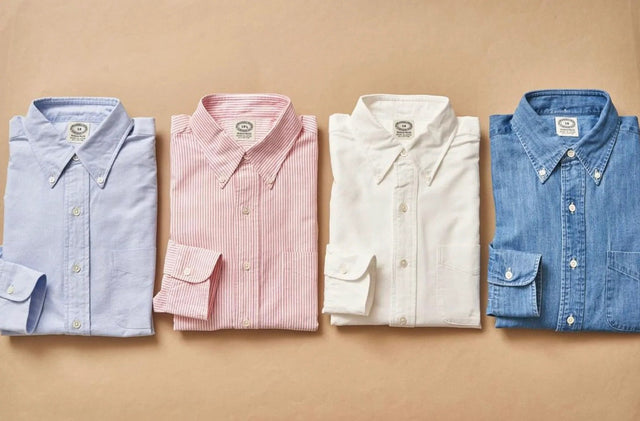
Kamakura Shirts: Ivy Button-Downs, Humble Beginnings, Made in Japan
In 1993 Yoshio and Tamiko Sadasue opened a small shirt shop in Kamakura, Japan, on the second floor above a convenience store. Both had worked for VAN Jacket, the company that brought American Ivy League clothing to Japan in the 1960s and 70s. By Kamakura’s account, Yoshio started the shop after VAN’s founder, Kensuke Ishizu, wondered who would carry on his wish to make Japanese men fashionable. That shop became Kamakura Shirts.
Two of its button-down cuts are now on the floor at 8025 102 Street, the Vintage Ivy and the Ametora. The Vintage Ivy is inspired by the Ivy League button-down of the 1960s. Here is how they differ, where the idea came from, and how to choose a size.
Kamakura photograph. Vintage Ivy oxfords and a chambray, folded.
The shirts
Vintage Ivy
Vintage Ivy is Kamakura’s collaboration with Graham Marsh, the British illustrator who co-wrote The Ivy Look, a pocket guide to classic American clothing. The first Vintage Ivy came out in August 2013. Kamakura says it has since reimagined the shirt, from the fabric and silhouette to the signature collar roll. We have it in a plain oxford in white, blue, ecru and pink, plus a blue university stripe and a blue chambray.
Kamakura photograph. The blue oxford under a navy jacket, the way most of ours will be worn.
Kamakura photograph. The chambray with dark denim.
Ametora
Ametora is Japanese slang for American traditional, the East Coast collegiate style that Kamakura says forged the Japanese menswear industry in the 1960s. The Ametora is Kamakura’s other button-down cut and the more classic of the two: a fuller cut with more room across the chest, a selvedge ID and extra detailing, and a more premium finish. We have it in white and blue.
Kamakura photograph. A white oxford button-down, open at the neck.
Kamakura calls the button-down the symbol of Ivy style. In 1965 the Japanese publisher Fujingaho brought out Take Ivy, a photo book of American Ivy League students. Kamakura says a team from VAN Jacket spent two weeks travelling through Ivy League campuses in the eastern United States to take the pictures. The book reached English readers in 2010 from powerHouse Books.
W. David Marx tells the wider story of how Japan took up American style in Ametora: How Japan Saved American Style, published by Basic Books in 2015.
The shop that became Kamakura
Yoshio named the shop Maker’s Shirt, meaning freshly made shirts, and Tamiko suggested adding Kamakura, after the town. By Kamakura’s account, the plan was a shop selling high quality shirts, with fairness and respect paid to the factory workers who made them. At some point people in Japan simply started calling it Kamakura Shirts, and the company kept that name when it opened in New York.
New York came in 2012. By Kamakura’s account, they found a property they wanted, and the building’s owner turned them down. Yoshio sent a letter and a button-down shirt to Graham Marsh, the British writer on Ivy style, and Marsh wrote the owner a recommendation that moved the talks forward. The shop opened at 400 Madison Avenue on 30 October 2012, and Marsh travelled from the UK for the opening. On that trip he asked Yoshio whether Kamakura could make his ideal button-down, and the Vintage Ivy launched the following year.
How Kamakura makes its shirts
Kamakura says it has kept production in Japan at every stage, from fabric and yarn to sewing, and that it works directly with its sewing factories and material suppliers instead of going through outside contractors. The shirts we received are labelled made in Japan.
The Vintage Ivy oxfords, the university stripe and the Ametora are all oxford cloth, a basket weave often used for button-down shirts. On its fabrics page, Kamakura describes its oxford as woven with thick yarns and a coarse, textured surface. The chambray is a different weave, a plain weave with coloured warp threads and white weft threads, which Kamakura says gives a soft, slightly iridescent colour effect.
Kamakura photograph. Oxford and chambray, folded.
How they fit
Both are sized by collar alone, in half sizes. Kamakura cuts them from a 14 collar to a 17.5, and the sizes we have on a given day are shown on each product page. The sleeve length is set by the collar size, so every collar comes with one sleeve and there is no choice of sleeve. If your arms run longer or shorter than usual for your neck, check the sleeve under your collar in the chart below.
Sizing Notes
Both cuts, side by side, in inches. Sizes are collar inches, and each collar has one sleeve length, the same in both cuts. Chest is the full distance around the shirt. Sleeve runs from the centre back of the collar to the end of the cuff. These are Kamakura’s own published measurements, and Kamakura allows 2% on them, so allow a little either way. Every measurement for each cut, in inches or centimetres, is on the Kamakura size guide.
Collar
14.5
15
15.5
16
16.5
17
17.5
Sleeve (from collar)
33.5
33.5
34.5
34.5
35.5
35.5
36.5
Vintage Ivy chest (round)
42.5
44.5
46.0
47.5
49.0
50.5
52.0
Ametora chest (round)
46.5
48.5
50.0
51.5
53.0
54.5
56.0
The Ametora is the fuller cut of the two, with more room across the chest than the Vintage Ivy at the same collar. Our Kamakura size guide lists Kamakura’s measurements for both cuts, so you can lay a shirt you already like against it. In Edmonton, come in and try your collar size. Anywhere else, tell us the collar and sleeve you wear now, in any brand, and we will help you choose. The shop’s number is 780-431-4293, or chat with us.
We met Kamakura in Paris in the summer of 2026, and we knew we had to bring it into the store. This kind of quality at this price is something we had been after for a while. And what a great business shirt.
We did not take the whole catalogue. We took two of its button-down cuts: the Vintage Ivy in white, blue, ecru and pink, with a blue university stripe and a blue chambray, and the Ametora in white and blue. The button-down oxford is the shirt we are asked for most in the $200 to $300 range, and until now the shelf between our Wythe and our Drake’s had a gap in it.
Kamakura’s own styling notes for the Vintage Ivy run from a navy blazer to chinos or dress trousers to denim.
Come see them
Both are on the floor at 8025 102 Street NW in Edmonton, and online at mrderk.com, shipping across Canada from Edmonton. Come in and try your size, or book a time. Regular-priced shirts have 14-day free returns, counted from delivery, and the details are on our returns page.
Frequently asked
Is Kamakura available in Canada?
Yes. We carry the Vintage Ivy and the Ametora at 8025 102 Street NW in Edmonton, and we ship across Canada from mrderk.com.
What is Kamakura Shirts?
A Japanese shirtmaker that began on 7 November 1993 in the town of Kamakura, started by Yoshio and Tamiko Sadasue, who had both worked for VAN Jacket. The company’s name is Maker’s Shirt Kamakura. It says it works directly with its sewing factories and material suppliers.
Where are Kamakura shirts made?
In Japan. The shirts we received are labelled made in Japan, and Kamakura says it has kept production in Japan at every stage, from fabric and yarn to sewing.
Who started Kamakura?
Yoshio Sadasue and his wife Tamiko, in 1993. Yoshio chose the name Maker’s Shirt, meaning freshly made, and Tamiko suggested adding Kamakura, after the town where the first shop opened.
Who is Graham Marsh?
A British illustrator and writer on Ivy style, and co-author of The Ivy Look, a pocket guide to classic American clothing. He and Yoshio Sadasue first met at the opening of Kamakura’s Madison Avenue shop in 2012. Kamakura says the collaboration began there, and the first Vintage Ivy shirt launched the next year.
What does Ametora mean?
Japanese slang for American traditional, the East Coast collegiate style that, in Kamakura’s words, forged the Japanese menswear industry in the 1960s. It is also the title of W. David Marx’s 2015 book, Ametora: How Japan Saved American Style, and the name Kamakura gives to one of its cuts.
What is the difference between the Vintage Ivy and the Ametora?
The Vintage Ivy is inspired by the Ivy League button-down of the 1960s. The Ametora is Kamakura’s other button-down cut. Kamakura’s size chart shows the Ametora fuller through the chest at the same collar size, and our Kamakura size guide has the measurements.
What size Kamakura shirt should I buy?
Both are sized by collar, in half sizes, with one sleeve length for each collar size. Our Kamakura size guide lists the measurements, so you can compare them with a shirt you already like. If you are not sure, come in or call the shop at 780-431-4293 with your collar and sleeve and we will pick it with you.
What is Take Ivy?
A photo book of American Ivy League students, first published in Japan in 1965 by Fujingaho. According to Kamakura, a team from VAN Jacket spent two weeks on Ivy League campuses in the eastern United States taking the pictures. powerHouse Books published an English edition in 2010.
What is oxford cloth, and how is chambray different?
Oxford cloth is a basket weave often used for button-down shirts, and Kamakura describes its oxford as woven with thick yarns and a coarse, textured surface. Chambray is a plain weave with coloured warp threads and white weft threads, which Kamakura says gives a soft, slightly iridescent colour effect.
Can you get a size that is not on the site?
Often, yes. The Vintage Ivy and the Ametora are stock lines at Kamakura, so a missing collar can usually be added to our next order. Ask by chat or call 780-431-4293.
Visit the shop
Try your size at 8025 102 Street, just off Whyte Avenue.